

SPCC Secondary Containment Sizing:
How to Calculate the 110% Rule for Your Site
For onshore oil and gas operators, EPA Spill Prevention, Control, and Countermeasure (SPCC) compliance is the daily discipline that keeps facilities running, inspectors satisfied, and the environment protected. At the heart of it sits one of the most misunderstood numbers in the industry: 110%. Get the calculation wrong, and your site risks failed inspections, Clean Water Act penalties, and costly remediation. Get it right, and you protect your people, your production, and your operating license.
Table of Contents
What the SPCC 110% Rule Actually Says
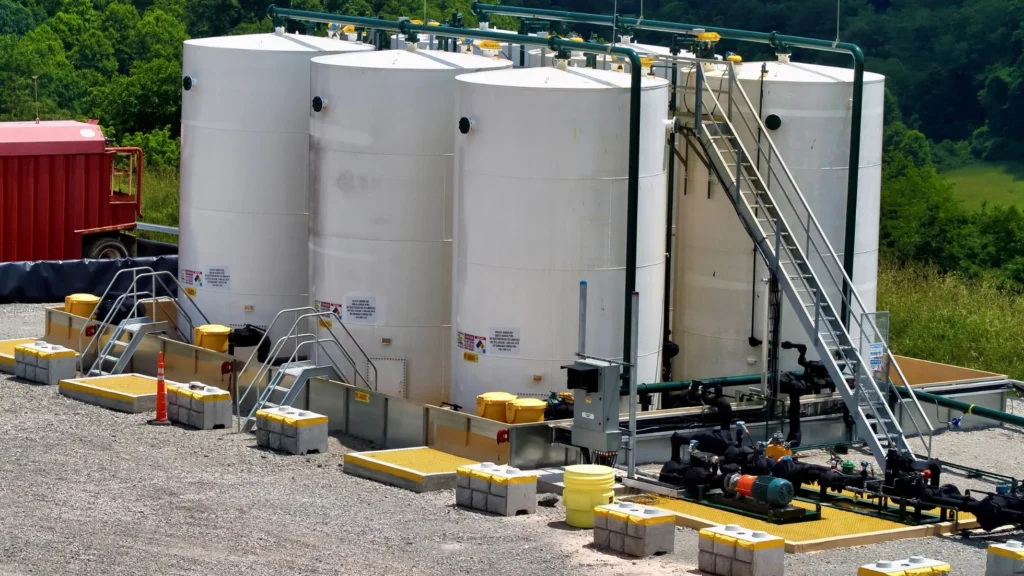
Under 40 CFR §112.8(c)(2), the SPCC Rule requires secondary containment to hold the entire capacity of the largest single container within the containment area, plus sufficient freeboard to contain precipitation. The widely cited 110% figure comes from industry best practice: 100% of the largest tank’s volume plus a 10% buffer for rainfall, snowmelt, and operational headroom.
That extra 10% is not arbitrary. It is the bare minimum cushion most engineers consider defensible. In wetter regions, the 25-year, 24-hour storm event may require significantly more freeboard than 10%.
Single-Tank Calculation
For a containment area with one bulk storage tank, the formula is straightforward:
Required Containment Volume = Largest Tank Capacity × 1.10
A 12,000-gallon crude oil tank, for example, requires a minimum containment capacity of 13,200 gallons. To verify your existing system, calculate the gross containment volume (length × width × wall height for a rectangular berm), subtract the volume displaced by the tank base, foundations, piping, and any equipment inside the containment footprint, then confirm the net available volume meets or exceeds the required figure.
Multi-Tank Configurations
When several tanks share one containment area, the rule shifts. Per EPA guidance and 40 CFR 264.175, the system must hold the greater of:
- 110% of the largest single tank, or
- 10% of the aggregate volume of all tanks combined
Consider three tanks with capacities of 10,000, 7,500, and 5,000 gallons (22,500 total).
- 110% of the largest = 11,000 gallons
- 10% of aggregate = 2,250 gallons
The required capacity is 11,000 gallons, the higher of the two. Always run both calculations. State and local fire codes can be stricter than SPCC, sometimes requiring containment for the entire combined volume of all tanks.
Common Mistakes That Cause SPCC Inspection Failures
Even experienced operators make calculation errors that show up during EPA audits. The most frequent issues include:
- Ignoring displacement. Tank bases, secondary tanks, valve manifolds, and piping all occupy space inside the berm. Failing to subtract their volume inflates your perceived capacity.
- Underestimating precipitation. A 4-inch storm event in West Texas drops far more water than a generic 10% freeboard accounts for. Pull site-specific data from the NOAA Precipitation Frequency Data Server for accurate 25-year, 24-hour values.
- Misjudging sloped containment. Sites with grading or settled soil have effective wall heights that vary across the footprint. The lowest wall height controls usable capacity, not the average.
- Forgetting accumulated rainwater. Containment areas that are not drained promptly lose capacity. Drainage valves must remain closed and locked, with documented inspection and release procedures.
- Outdated calculations. Adding a tank, replacing equipment, or modifying piping changes the math. Recalculate every time the configuration changes.
How System Type Affects Compliance
Not all containment is created equal. Earthen berms degrade, crack, and absorb hydrocarbons over time, often losing capacity invisibly between inspections. Engineered systems built on impermeable barriers, such as AssetGuard’s GroundGuard pre-sprayed polyurea liner, maintain their geometry, prevent migration into subsoil, and deliver predictable, calculable volume year after year.
Surface-mounted, post-driven, and 12-inch Cee purlin containment systems offer engineered wall heights and known footprints, making your 110% calculation defensible to any inspector. With over 17,000 containment installations across North America, AssetGuard and Falcon Technologies design systems that meet SPCC sizing requirements out of the spec sheet, not after the fact.
The Bottom Line
The SPCC 110% rule is the floor, not the ceiling. Account for displacement, real-world precipitation, sloped terrain, and configuration changes, then build in a margin. Compliance is not a one-time calculation; it is an ongoing engineering discipline.
Need help verifying whether your site meets SPCC requirements? Contact AssetGuard to discuss containment sizing, design, and installation tailored to your facility.