5 Questions to Help Decide Which Spill Containment Barrier Is Right for Your Facility
Choosing the right spill containment barrier is an operational decision that affects compliance, safety, and the efficiency of a facility’s day-to-day operations. While both 6-inch berm containment and 12-inch Cee purlin containment are proven systems, they solve different problems. The right choice depends on how your site operates, not just what is stored.
Table of Contents
1. What spill containment barrier best matches your facility’s spill volume?
Containment should be sized based on credible spill scenarios, not theoretical extremes.
A 6-inch berm containment system is often appropriate when spill risk is limited to smaller releases such as hose failures, connection points, or incidental leaks. Common uses for these systems are around totes, pumps, generators, and modular equipment layouts where flexibility matters.
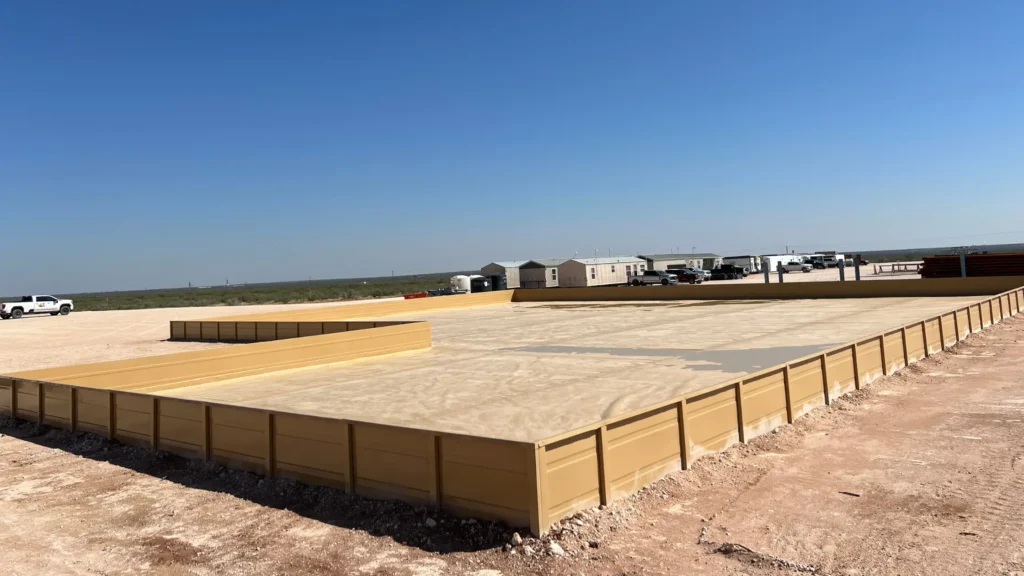
A 12-inch Cee purlin containment system supports higher containment volumes and is better suited for larger tanks, regulated fluids, or facilities that require a more conservative spill planning approach.
2. How much vehicle and equipment traffic moves through the area?
Traffic patterns are one of the most overlooked factors in containment design.
Lower-profile berm systems allow easier drive-over access for trucks, forklifts, and service equipment. This makes them a practical spill containment barrier in active areas where frequent movement is unavoidable.
Cee purlin systems introduce a rigid perimeter that requires defined access points. While this structure supports higher containment capacity, it is typically better suited for controlled traffic environments and fixed layouts.
3. Is the containment system temporary, modular, or permanent?
Facilities evolve, and containment should align with that reality.
Common berm system selection is for temporary or modular installations where equipment relocates or layouts adjust over time. Their flexibility supports phased development and operational changes.
Cee purlin containment selection is for long-term infrastructure. The steel-supported design is for permanent installations.
4. What fluids are managed within the containment area?
Fluid type directly influences containment requirements.
Lower-risk or water-based fluids may be effectively managed with a berm system when spill volumes are limited. Higher-risk fluids such as hydrocarbons or produced water often justify a more robust spill containment barrier with greater structural support and wall height.
Matching containment design to the fluid profile helps avoid overbuilding while still supporting environmental and regulatory expectations.
5. How should a spill containment barrier support operations rather than restrict them?
Containment should function as a control measure, not an obstacle.
Oversized systems can complicate maintenance and restrict access. Undersized systems can expose a facility to unnecessary risk. The most effective spill containment barrier is one that integrates into daily operations without disrupting workflow and performs reliably when needed.
FAQ
Can a facility use both berm and Cee purlin containment on the same site?
Yes. Many facilities deploy different spill containment barriers based on equipment type, fluid risk, and operational activity.
Is higher containment always better?
No. Effectiveness depends on fit, not height alone.
Which system is easier to deploy?
Berm systems typically allow faster deployment, while Cee purlin systems require more planning and permanent integration.
How should facilities confirm the right containment approach?
By evaluating spill scenarios, traffic patterns, fluid types, and long-term operational plans together rather than in isolation.
A practical next step
If you are evaluating containment options for a new facility or reassessing an existing layout, reviewing spill scenarios and operational constraints early can prevent costly redesigns later. Having a containment partner who understands how these systems function in real-world conditions can help clarify which approach makes the most sense for your site.