

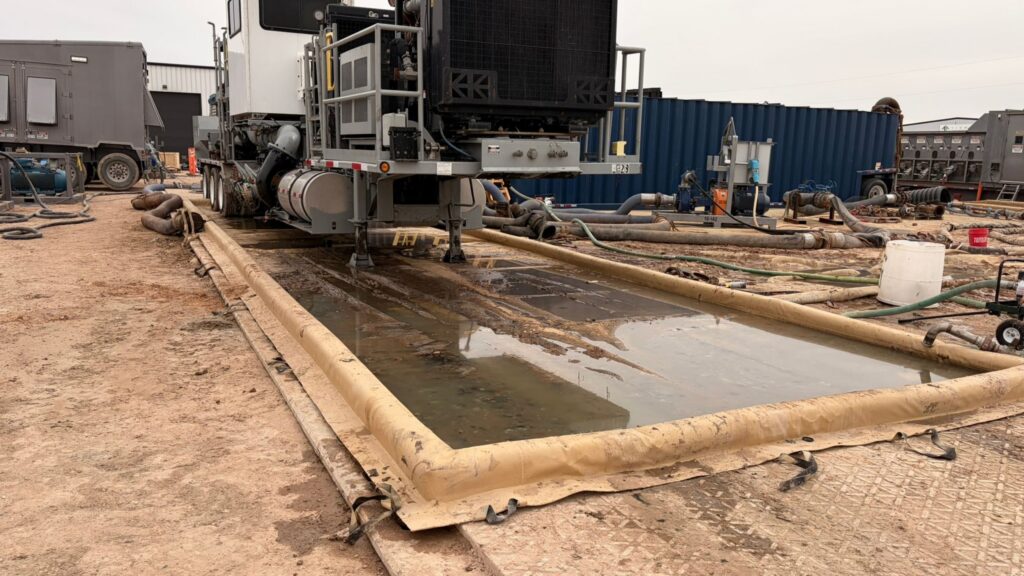
Spill Containment and SPCC Inspections: What Inspectors Actually Question
During SPCC inspections, portable containment systems are evaluated as operational controls. Inspectors compare what the SPCC plan states with what is staged, deployed, and functioning in the field, and any gap between those two views draws attention regardless of whether a release has occurred.
Portable systems surface weaknesses quickly because they move between sites, are reused under different equipment, and experience wear that fixed infrastructure does not. Inspectors focus on performance and consistency, not on labels such as temporary or mobile.
Table of Contents
What do inspectors look at first during a field review?
1. Capacity relative to equipment in use
Inspectors compare available volume to the equipment staged within it.
Issues that draw scrutiny include:
- Systems reused under larger equipment than originally evaluated
- Multiple assets placed within a single containment area
- Equipment upgrades not reflected in sizing assumptions
Redeployment without reassessment is one of the most common inspection triggers, even when no release has occurred.
2. Physical condition and integrity
Portable systems are expected to remain functional throughout their service life.
Inspectors commonly examine:
- Seams for separation or stretching
- Base materials for abrasion from traffic
- Sidewalls for loss of rigidity
- Signs of overtopping or fluid migration
Wear alone is not a finding. Wear without inspection or repair documentation often is.
Why does inconsistent deployment raise compliance concerns?
Inspectors routinely ask how and when containment is used. The issue is control.
Typical questions include:
- Is containment always used during this activity?
- Who determines when it is required?
- Is that decision supported by written procedures?
- Does field practice match the documented approach?
Inconsistent use signals a lack of operational discipline, even when the equipment itself is adequate.
How should portable systems be described in an SPCC plan?
Plans often reference portable containment with minimal specificity. During inspections, that lack of clarity becomes a liability.
Language that frequently prompts follow up includes:
- Used as needed
- Deployed when required
- Available onsite
Inspectors expect plans to clearly state:
- Which activities trigger deployment
- Where equipment is staged
- Who is responsible for inspection
- How adequacy is confirmed
Clear descriptions reduce interpretation and inspection friction.
Are inspection records expected for portable containment?
Yes. Portable systems are expected to be included in inspection programs, even when checks are visual and brief.
Common deficiencies include:
- No inspection records
- Records that do not identify individual units
- Inspections performed but not documented
- Repairs made without notation
Inspectors often treat undocumented processes as nonexistent processes.
How do inspectors interpret “temporary” in practice?
Temporary is interpreted by function, not duration.
Inspectors consider:
- Frequency of redeployment
- Length of use at a single location
- Exposure to traffic or heavy equipment
- Environmental conditions such as temperature and UV exposure
A system used daily over extended periods may be treated as semi permanent, regardless of internal labeling.
What issues most often lead to inspection findings?
Findings are usually incremental rather than catastrophic. They reflect drift over time.
Common patterns include:
- Capacity no longer aligned with equipment
- Degradation from repeated redeployment
- Disconnect between plan language and field practice
- No clear ownership of inspection and upkeep
These issues are typically correctable but often require plan revisions and follow up inspections.
How can operators prepare without overengineering?
Preparation is about alignment, not redesign.
Effective steps include:
- Verifying capacity against current equipment
- Including portable systems in inspection records
- Updating plan language to reflect actual use
- Retiring equipment that no longer performs reliably
Inspectors respond well when operators can clearly explain what they are doing, why it works, and how they know it works.
What inspection-ready spill containment actually requires
Portable systems are evaluated during SPCC inspections based on performance, consistency, and documentation. Findings almost always trace back to misalignment between what is written, what is deployed, and what is maintained in practice.
When capacity matches equipment, deployment is predictable, and inspection records are defensible, portable systems rarely become a point of contention. When any one of those elements drifts, it quickly becomes a focal point for inspectors.
If your operation relies on mobile or temporary controls, aligning containment strategy with real field conditions before an inspection reduces risk and avoids corrective actions. AssetGuard works with operators and EHS teams to evaluate containment performance, deployment practices, and SPCC alignment so systems hold up under inspection, not just on paper.