

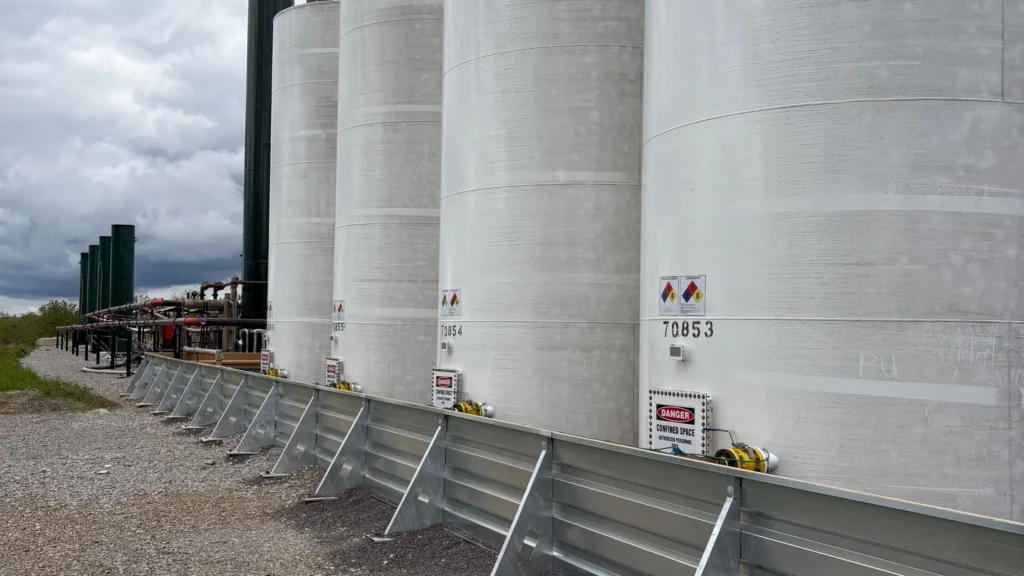
Secondary Containment During Tank Battery Workovers and Equipment Changeouts
Secondary containment requirements don’t pause when a tank battery comes down for maintenance. During workovers and equipment changeouts, spill risk goes up at the same time the permanent containment system is most exposed to damage. Managing that window comes down to three things: temporary containment at every new transfer point, physical protection for the liner and berm walls, and a documented inspection before the site returns to service.
Table of Contents
Why Do Changeouts Increase Spill Risk at a Tank Battery?
Under the EPA SPCC rule (40 CFR Part 112), secondary containment at a bulk storage installation must hold the full capacity of the largest single tank plus freeboard for rainfall. Some states go further. North Dakota requires capacity for the largest tank plus one day’s production. Either way, the sizing assumes every release starts inside the bermed area.
A changeout breaks that assumption. Transfer hoses run over the berm wall to a frac tank staged outside the containment. Flowlines get broken at flanges beyond the lined footprint. A vacuum truck parks wherever the driver can reach the header. Each of these creates a release point the containment system was never designed to catch, and it happens during the one window when fluid is guaranteed to be moving.
The site plan in the SPCC plan shows the battery in its operating configuration. During maintenance, the actual configuration changes daily. Treat every temporary hose, open flange, and staged tank as its own release point and contain it accordingly.
Residual Fluid: the Volume the Gauge Does Not Show
A 400-barrel stock tank that gauges empty still holds fluid. Tank bottoms carry paraffin, sediment, and oil-cut water sitting below the drain connection. Flowlines hold their full volume between valves and release it as soon as a flange is cracked at a low point. Heater treaters and gun barrels retain fluid in internal sections that never drain through the primary outlet.
That residual stays put while the vessel sits level. It moves the moment a crane picks the tank and the angle changes, and it moves toward whatever fitting is open. Lift plans should account for residual volume, not gauged volume. Purge, flush, and blind lines before they are broken, and set drip containment under every open connection before the first bolt comes out.
How Cranes and Heavy Equipment Damage Containment Liners
Polyurea liners and coatings are engineered to resist fluid, weather, and UV exposure for years. They are not engineered for concentrated mechanical loads. The most common damage sources during a changeout include:
- Crane outriggers set directly on the lined surface, forcing aggregate through the membrane
- Skid steers and tracked equipment pivoting in place on the coating
- Welding slag and hot work performed over or near the liner
- Dropped valves and fittings, and skids dragged instead of lifted
The most expensive damage is the kind that gets covered up. A puncture under a tank base that has been set back in place cannot be seen or repaired until the next changeout, and it will not announce itself until fluid finds it.
Prevention is basic and cheap. Put outrigger mats and ground protection under every track, tire, and outrigger. Flag travel corridors so trucks stay off berm walls. Stage tools, spoil, and hardware on mats, not on the liner. This is a ten-minute conversation in the pre-job safety meeting, and it prevents most of the liner damage we get called out to repair.
Temporary Containment Requirements During Maintenance
SPCC compliance does not lapse while equipment is out of position. EPA guidance on secondary containment distinguishes passive containment, which works without human action, from active measures such as absorbents, which require someone to notice the spill and respond. During a workover, when the crew is focused on the lift, passive containment is the only kind worth relying on.
A maintenance containment plan for a tank battery should include:
- Portable berms under every temporary transfer point and hose connection
- Drip containment under open flanges, broken unions, and disconnected lines
- A lined staging pad for vacuum trucks and frac tanks that will stay on location
- Reusable spill containment staged on site before the first line is broken, not ordered after the first drip
Pre-startup Inspection: What to Check Before Returning to Service
Before fluid flows again, someone who knew the containment before the work started should walk the site and document its condition. The inspection should include:
- Walking the full liner surface, concentrating on areas where equipment traveled, outriggers set, or loads were staged
- Inspecting the base surface under every tank and vessel before it is set back down; Once the tank is loaded, that surface is unreachable until the next changeout
- Checking berm walls for impact damage and inspecting every penetration boot disturbed when lines were broken and remade
- Confirming drain valves are closed, sumps are clean, and stormwater that accumulated during the work is inspected before draining
- Photographing the containment as returned to service and updating the SPCC plan if tank positions, capacities, or piping runs changed
Damage found on that walk is a repair item. Containment reline and repair services can patch a puncture or recoat a damaged section during recommissioning. The same defect found under a release later is a reportable incident, a cleanup, and a much harder conversation with the regulator.
Plan the Containment Before the Crane Arrives
If a workover or changeout is on your schedule, it’s worth a conversation first. AssetGuard and Falcon Technologies have completed more than 17,000 containment installations, and we can help you plan temporary containment, ground protection, and the pre-startup inspection around your job scope. Reach out when the work order is issued, not after the walk-down finds a problem.
Frequently Asked Questions
Is secondary containment required during tank battery maintenance?
Yes. SPCC requirements under 40 CFR 112 apply continuously, including during workovers and equipment changeouts. Temporary transfer points, staged tanks, and open connections all need containment even though they do not appear in the facility’s normal site plan.
What temporary containment is needed during a workover?
Portable berms at every transfer point, drip containment under open flanges and broken lines, and a lined staging area for vacuum trucks or frac tanks that remain on location. Passive containment is preferred because it works without anyone deploying it.
What causes containment liner damage during equipment changeouts?
Crane outriggers, pivoting skid steers, welding slag, and dropped or dragged components are the leading causes. The highest-risk damage is a puncture under a re-set tank base, because it stays hidden until the liner is needed.