5 Reasons GroundGuard Stands Out Among Secondary Containment Solutions
The best secondary containment solutions do more than hold fluid. They let you prove the containment is still intact. GroundGuard, AssetGuard’s pre-sprayed polyurea liner, earns that trust in five ways: damage is easy to see, there are no field seams to fail, repairs stay inspectable, the liner stands up to harsh field conditions, and one team owns it from manufacturing through repair.
Table of Contents
Why Should Secondary Containment Solutions Be Easy to Inspect?
An inspection can only confirm what the inspector can see. Under the EPA’s SPCC rule in 40 CFR Part 112, facilities must inspect according to written procedures and keep signed inspection records with the SPCC Plan for three years. However, that signature only certifies what was visible on the day of the walk.
Picture a routine inspection at a tank battery. A pinhole from a dropped fitting can pass unnoticed if the liner surface doesn’t reveal it. So can a puncture where someone dragged a skid during a workover or equipment changeout. The damage stays in place, and it stays silent until fluid finds it. By then, a simple repair has become remediation, a possible reportable incident, and downtime.
That’s why the containment you can trust most is the containment you can verify. Here’s how GroundGuard makes verification easier.
1. You Can See Damage Before It Becomes a Leak
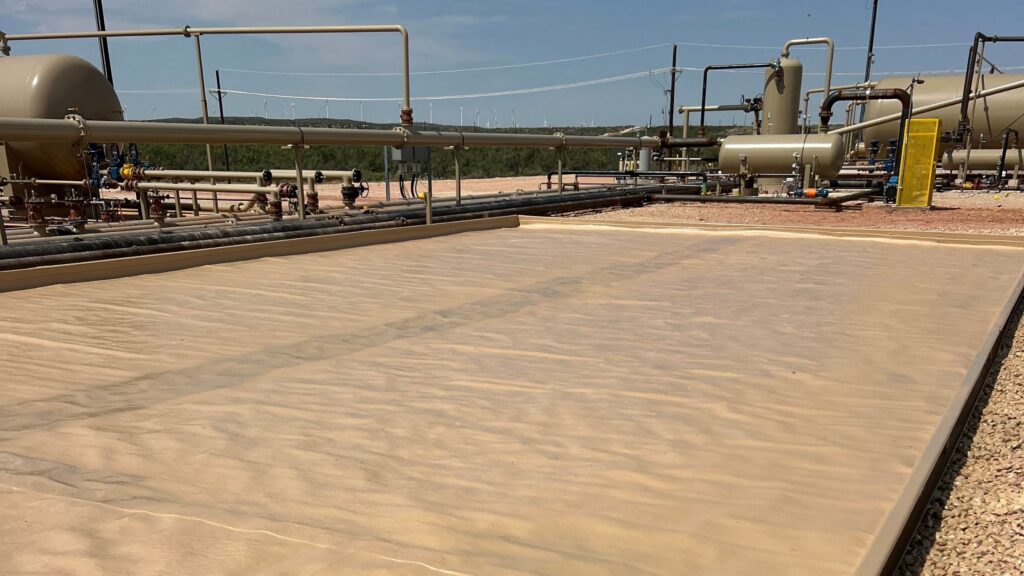
A small puncture is only as visible as the surface around it. That’s why standard GroundGuard is tan. The light, non-porous coating helps pinholes, punctures, and surface damage stand out. That visibility helps AssetGuard’s quality control team spot defects before the liner ships, and it helps your crews during routine on-site inspections.
The surface also stays readable over time. Spills remain on top instead of soaking in, so crews can see them, recover them, and clean up. In addition, debris clears easily, and weeds and grasses have nowhere to take root. As a result, the liner stays clean enough to inspect season after season.
Prefer containment that blends in? GroundGuard also comes in green and black. Tan is simply the best choice when visibility is the priority.
2. There Are No Field Seams to Fail
Every field seam is a joint that a crew has to make correctly under site conditions. Then someone has to verify it. Seams are a common leak path in any containment system, so each one adds another place for failure to hide.
GroundGuard ships in continuous sheets. That means there are no field seams to weld, fewer potential leak paths, and less to worry about between inspections.
3. Repairs Don't Leave New Weak Spots Behind
Even a tough liner can take a hit from a dropped valve or a misplaced outrigger. What matters next is whether the repair restores confidence or creates a new question mark.
When GroundGuard is damaged, the repair material bonds directly to the coated surface. The repair adds no weld seam, and crews can fully cover and inspect it just like the original liner. So the repaired area returns to service as reliably as the rest of the containment.
Not sure whether an older liner needs a patch or full replacement? Review the warning signs of liner failure, then contact our containment reline services team to determine the right solution.
4. It's Built for the Conditions Oil and Gas Sites Face
Inspectability tells you when something is wrong. Durability keeps things from going wrong in the first place.
GroundGuard combines a reinforced geotextile substrate with AssetGuard’s proprietary modified polyurea coating. An automated, continuous process applies the coating for consistent thickness across every sheet. AssetGuard also engineers and tests the liner to resist most chemicals common in demanding industrial environments.
Traction matters, too. Optional slip-resistant media embedded in the coating gives crews solid footing, even on frosty mornings when the inspection walk still has to happen.
| Property | Published GroundGuard Value |
|---|---|
| Permeability | 0.05 perms |
| Puncture resistance | Up to 214 lb, depending on construction |
| Taber abrasion | 1.0 mg loss per 1,000 cycles |
| UV and weathering | Physical property retention tested after 2,500 hours of QUV exposure |
| Service temperature | -40°F to 200°F, long term |
| Coefficient of friction | 0.89 wet / 1.14 dry (with slip-resistant media) |
| Stated useful life | More than 20 years |
GroundGuard is also reusable. Crews can clean it, trim it, and redeploy it on another site, from truck and equipment pads to temporary tank containment.
5. One Team Owns It From Manufacturing to Repair
Finding damage is only half the job. Someone still has to fix it, quickly and correctly.
AssetGuard manufactures GroundGuard, and Falcon Technologies installs, services, repairs, and warranties it. So when an inspection turns something up, you make one call to the team that knows the liner best.
Falcon Technologies brings more than 20 years of experience installing polyurea-lined secondary containment. The company holds MSAs and is approved to work with over 400 companies nationwide. Meanwhile, AssetGuard keeps detailed documentation for every site and product, including batch and lot traceability for raw materials. That paper trail supports the records your SPCC Plan depends on.
How Do You Compare Secondary Containment Solutions?
Start with the basics: capacity, compatibility with the fluids you store, and site conditions such as traffic and climate. Our guide to SPCC secondary containment sizing covers the capacity math. Next, ask how much of each option you can verify. These questions make a useful checklist for comparing secondary containment solutions:
- Could someone spot a pinhole during a normal inspection walk?
- How many field seams does the system have, and how does each one get verified?
- Does a repair add a new seam, or can crews inspect it like the original surface?
- Do spills stay on the surface for recovery, or can they become trapped within?
- Can people walk the liner safely in wet and icy conditions?
- When damage turns up, how many companies are needed for the repair?
If the answers are uncertain, containment is too.
Frequently Asked Questions About Secondary Containment Solutions
What are secondary containment solutions?
Secondary containment solutions are systems that capture fluid released from a primary container, such as a tank, vessel, pipe, or drum, and hold it until crews can recover it. At oil and gas sites, they typically include liners, containment walls, tank bases, and catch basins that keep oil, produced water, and chemicals out of soil and groundwater.
How often should secondary containment be inspected?
The SPCC rule requires inspections on a schedule set by your facility’s written procedures and applicable industry standards, not a single federal frequency. Many operators pair frequent visual walk-throughs with less frequent formal inspections. Whatever the schedule, keep signed inspection records with your SPCC Plan for at least three years.
What happens if an inspection finds damage to a GroundGuard liner?
Document the damage, recover any fluid, and schedule the repair. Falcon Technologies handles GroundGuard repairs, and the repair material bonds directly to the coated surface without adding a weld seam. As a result, crews can inspect the repaired area just like the rest of the liner.
How long does GroundGuard last?
GroundGuard has a stated useful life of more than 20 years, backed by a 10-year warranty. Actual service life depends on site conditions, traffic, and maintenance, which is why routine inspection remains important throughout the life of any liner.
Is GroundGuard made in the USA?
Yes. AssetGuard manufactures GroundGuard and its other polyurea-based products in America and is a Build America, Buy America (BABA) manufacturer. The company is headquartered in Decatur, Texas, with additional locations in Midland, Texas, and Bellaire, Ohio.
Get Secondary Containment Solutions You Can Verify
Containment you can trust is containment you can verify. AssetGuard and Falcon Technologies have completed more than 17,000 containment installations and installed more than 52 million square feet of GroundGuard. Whether you’re building a new site or weighing a reline, we can help you choose secondary containment solutions that fit your job scope. Contact AssetGuard or call our Decatur headquarters at (817) 639-2138.